In complex operational environments, humans are constantly bombarded with dynamic, messy data. The real challenge isn't just generating an accurate forecast—it's translating that forecast into safe, actionable decisions under pressure.
AI in Healthcare
In hospitals, decisions carry life-or-death consequences. Whether it's prioritizing patients in a crowded ER, adjusting nurse staffing to prevent burnout and ensure safety, or managing critical medical supplies, AI serves as an intelligent "control tower." By evaluating clinical acuity, wait times, and supply chain signals, AI agents can recommend specific actions, escalate risks, and generate auditable documentation—always keeping the human clinician in the final loop.
AI in Industry & Warehousing
For industrial and warehouse logistics, the focus shifts to efficiency, cost-control, and labor optimization. Machine learning predicts volume spikes and workflow bottlenecks. Decision-support agents then evaluate these forecasts against business logic to recommend voluntary time off (VTO) or extra time (VET), optimizing labor spend while maintaining throughput.
AI in Critical Infrastructure & Energy
Managing power grids and utility networks requires balancing fluctuating demand with absolute stability. AI agents can monitor grid health, forecast load spikes, and recommend preventative maintenance or load-shedding strategies—ensuring uptime and safety in critical infrastructure.
The common thread: Whether managing a hospital ER, a busy fulfillment center, or a power grid, the underlying technology is the same. By synthesizing data, applying deterministic safety guardrails, and using agents to coordinate logic, we build transparent systems that empower human operators rather than replacing them.
The Core AI Engine
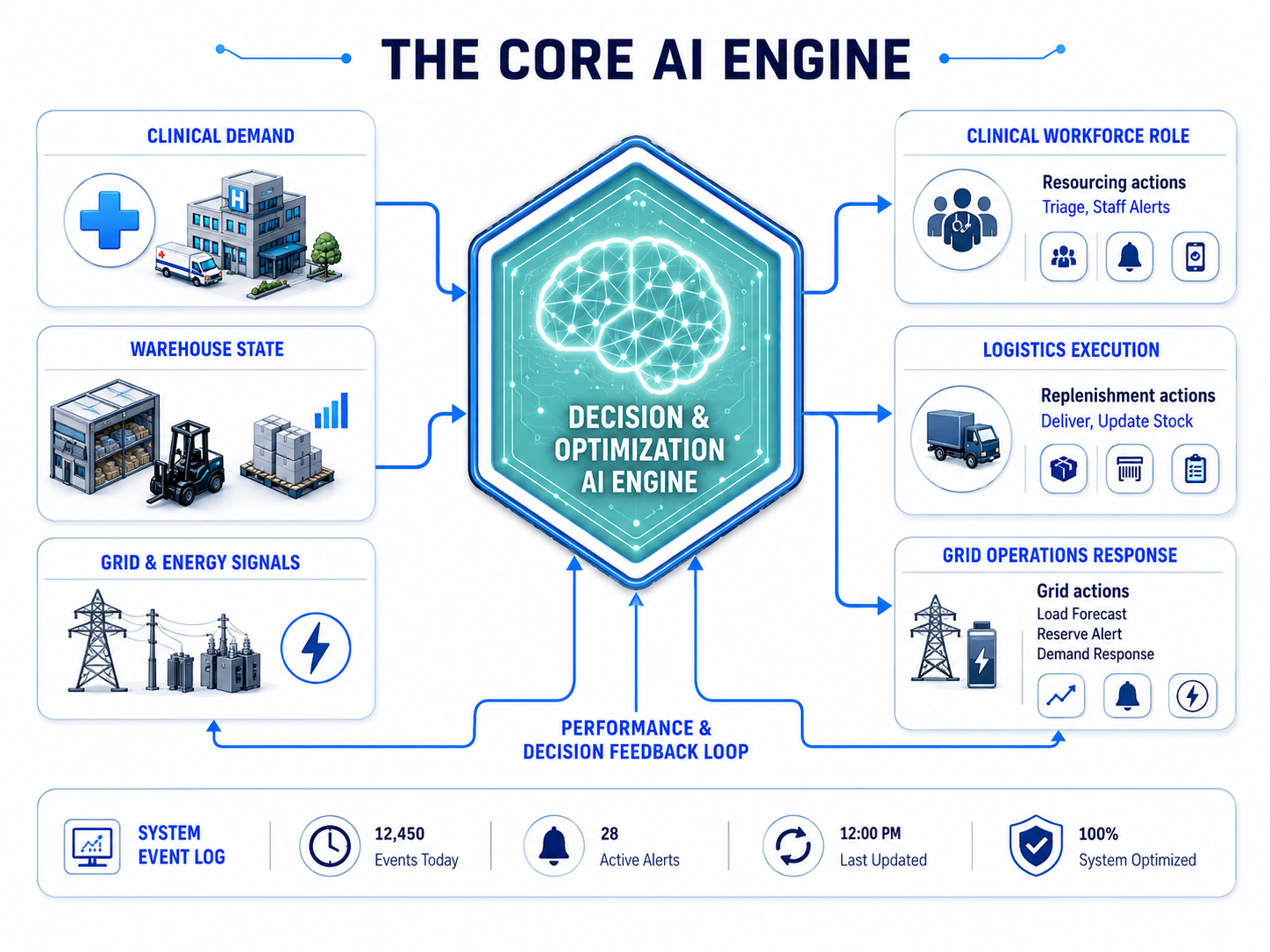
By unifying data streams from clinical demand, warehouse states, and grid and energy signals, the centralized AI engine acts as a common decision layer across critical operations. It converts forecasts, near-real-time telemetry, and scenario stressors into explainable recommendations—supporting staffing decisions, replenishment actions, and grid-risk responses from one governed AI core.
A continuous feedback loop ensures that every recommendation—whether produced by predictive analytics, deterministic rules, or multi-agent reasoning—and every human override is logged, reviewed, and used to improve future performance. The result is a transparent, auditable operating model for healthcare, logistics, and energy environments.